Transport Fever 3: How to Compare Cargo Route Costs
Compare complete delivery chains over the same observation period. Record delivered-cargo revenue, vehicle running costs and the upkeep of the infrastructure each option needs. Keep construction spending and loan movements separate. A profitable line alone does not establish that its whole chain is the better use of your money.
This worksheet is a planning tool, not a prediction of your save's earnings. Fill it with your own observed figures. An unavailable cost stays unknown; it must not quietly become zero.
Follow the cargo to its paying destination
A warehouse is an intermediate storage and transfer point. Cargo sitting there still needs an onward delivery leg to reach a town or factory. Comparing only the leg into storage leaves the chain incomplete.
Delivery time and aerial distance affect cargo income. Adding travelled distance is therefore not a reliable way to forecast a larger payment. A longer detour can consume vehicle time without adding equivalent value to the delivery.
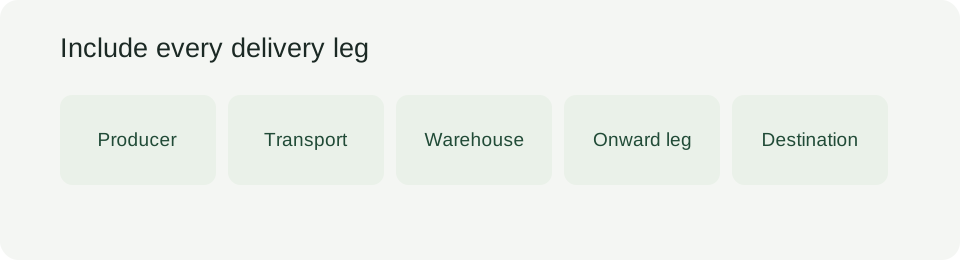
Specialized warehouse storage can freeze a cargo delivery timer and improve loading and unloading. That does not make the warehouse a final customer. Separate the storage benefit from the extra vehicles and infrastructure needed to finish delivery.
Copy a ledger before changing the route
Download the cargo-cost worksheet (CSV). The same fields appear below. These are recording fields, not fabricated game measurements.
| Field | Option A | Option B |
|---|---|---|
| Game build, difficulty and time settings | Record | Record |
| Observation start and end | Record | Record |
| Cargo and final destination | Record | Record |
| Delivered-cargo revenue | Observed value | Observed value |
| Vehicle running costs | Observed value | Observed value |
| Station, road, track and warehouse upkeep | Observed or explicitly allocated | Observed or explicitly allocated |
| Construction and vehicle purchases | Separate investment | Separate investment |
| Loan interest and principal movements | Separate entries | Separate entries |
| Subsidies or other non-cargo receipts | Separate entries | Separate entries |
| Missing information | List unknowns | List unknowns |
Define an operating remainder for this comparison: delivered-cargo revenue minus vehicle running costs minus the infrastructure upkeep allocated to the chain. This is an audit definition. It is not a claim about an undocumented internal profit formula.
A shared station needs an allocation rule. For a small change to an existing network, record the additional upkeep that the change introduces. For a new dedicated chain, record its dedicated infrastructure. Do not charge one option for an entire shared hub while giving the other free access to the same hub.
Run a comparison that can survive a second look
Save the baseline before rebuilding. Record the build and settings, then observe both options for matching periods. Change one decision at a time: the vehicle choice, the transfer arrangement or the route. Several simultaneous changes make the cause of a better result difficult to identify.
Match the cargo, destination and accounting scope. Calendar-speed settings can change how production, consumption and maintenance are represented across calendar time. A result from one setting should not be compared casually with a result from another.
A truck chain can outperform a train chain when the train option carries infrastructure that its traffic cannot justify. That is a hypothesis to test in your save, not a universal verdict against trains. Conversely, sharing a well-used rail connection changes the cost question: the next service may require much less new infrastructure than the first one did.
A warehouse can improve storage behavior while still making the complete chain more expensive. Both statements can be true. Compare the reduction in delivery problems with the added operating burden instead of treating the presence of a warehouse as proof of efficiency.
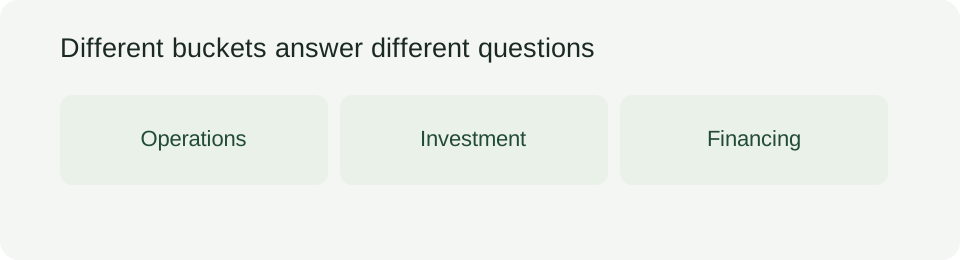
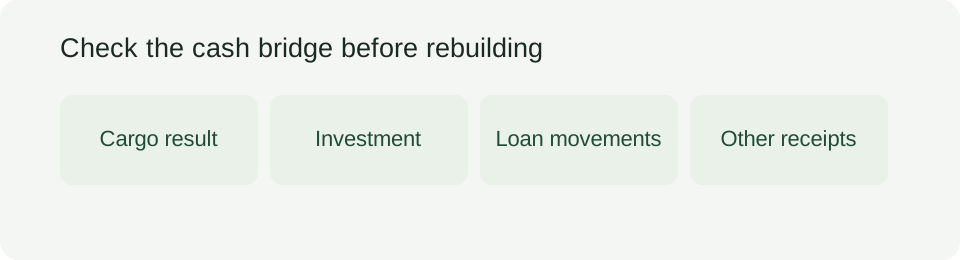
When the bank balance falls despite an apparently healthy line, inspect investment and financing before rewriting the route. Construction spending and principal repayments belong to a different explanation from weak cargo earnings. Interest remains a cost; a loan receipt is not a cargo sale.
Does a large bank balance mean the game is too easy?
A large balance in an early era does not settle that question. It does not tell you which settings were used, which receipts came from cargo, how much infrastructure is already paid for, or whether the next expansion will sustain itself.
Check the ledger before judging the challenge. If a mature chain covers its recurring costs without exceptional receipts, that supports a narrower conclusion: this chain is sustainable under these conditions. It does not establish that every route, era or difficulty setting will behave the same way.
The useful next decision is concrete. Keep the cheaper complete chain when it delivers the required cargo reliably; investigate the more expensive one only when you can name the service benefit it buys. If a decisive upkeep figure is missing, leave the choice unresolved until you record it.