Transport Fever 3 Wishlist: Which Changes Would Improve Your Playthrough?
The most useful Transport Fever 3 wishlist starts with the action you cannot finish comfortably: finding suitable mods, keeping construction controls visible, or understanding a cargo transfer. Ask for a change that removes that obstacle. A longer feature list will not necessarily make your next play session better.
This guide recommends how to prioritize requests; it does not announce upcoming updates. Review date: 7 October 2026. Suggestions below are proposals, not promises or a claim that every request remains unresolved in your installed build.
Choose the interruption you want removed
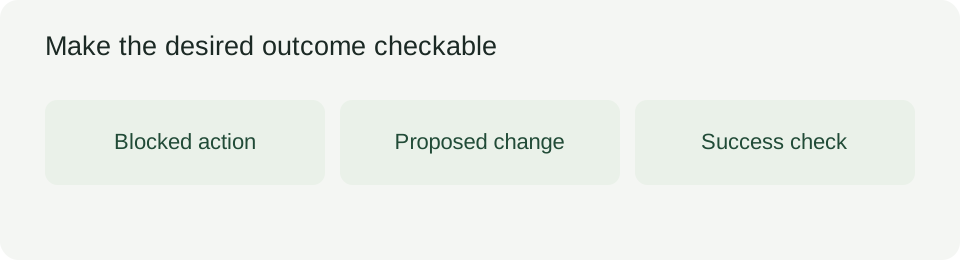
Start here. Each row describes a desired outcome, rather than a release commitment. Check your current build before submitting a request.
| Your task | Proposed improvement | What success would look like | What to record |
|---|---|---|---|
| Find mods for a new save | Exclude unwanted categories and narrow results by recency | The useful results remain visible without repeatedly clearing unrelated entries | Your search, category and result you wanted hidden |
| Enable a chosen collection | Bulk selection with a preview of affected items | You can review the selection before applying it | Which items should change and which should stay untouched |
| Adjust a building beside a vehicle window | Compact windows and predictable panel ordering | The relevant construction controls stay reachable | Open panels and the control being covered |
| Extend a freight transfer | Clearer explanation of storage and loading roles | You can identify which object addresses the actual bottleneck | Transfer layout, selected object and confusing indicator |
Download the blank wishlist planner (CSV). It is a worksheet for your observations, not a dataset of measured game results.
Better mod discovery is different from more mods
A mod collection can be accessible and still awkward to navigate. Useful requests include hiding an unwanted content category, browsing recent additions and selecting several items together. Those changes address the path to an existing item. Adding more content alone does not address that path.
Unique mod IDs and dependency detection already belong to the described mod-management design. A wishlist should therefore identify the remaining selection or discovery problem, rather than treating every part of mod handling as absent.
Our recommendation is to pair bulk selection with a review step. “Enable everything” is ambiguous: everything installed, everything subscribed to, or everything currently filtered? A clear selection boundary matters more than a large button. Your request should name that boundary and explain what must remain untouched.
For filters, describe the item you were trying to find and the unrelated category you wanted removed. That is a sharper request than “make the browser better.” It gives the improvement an observable result without pretending to know the development effort involved.
Keep the control you are using within reach
A compact vehicle window and dependable construction-panel ordering address a different frustration: losing access to the next control. These are interface requests, not requests for new vehicles.
Describe the sequence. Open the vehicle panel, enter the relevant building tool, then identify which setting becomes covered. Include the window arrangement and game build. Do not turn an interrupted action into a blanket claim that the entire interface is broken.
Our proposed acceptance check is simple: after selecting a building, can you reach its settings without closing an unrelated vehicle panel? If yes, that specific interaction has improved. It says nothing about other windows, so keep the request scoped to the obstruction you can reproduce.
Warehouse wishes point in opposite directions
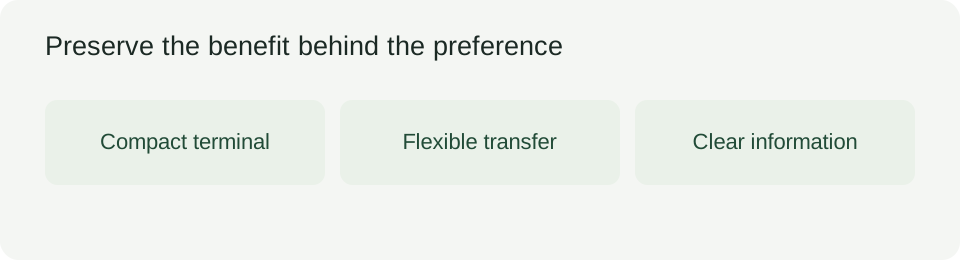
A warehouse integrated into a station can feel tidy. A separate warehouse can feel flexible. Those preferences conflict when the same redesign is expected to satisfy both kinds of layout.
Warehouses expose stored cargo by module, including supported types, quantity and average remaining delivery time. Specialized modules let you select a cargo type. Before proposing a redesign, identify whether your obstacle is the footprint, the connection layout or the information displayed.
The recommendation here is to preserve the useful outcome of each approach. A compact integration option could suit tightly packed terminals; retaining independent placement could suit transfer networks. This is a design proposal, not a feature that is confirmed to exist or be planned.
Clarity may be the smaller change with the larger practical benefit. Separate storage capacity, loading behavior and cargo routing in the request. If you cannot tell which one is holding up a transfer, ask for a clearer explanation of those roles before assuming that moving the building would fix the flow.
Turn a preference into a request you can check
Copy this template into your own notes:
I am trying to [complete a specific action]. With [build, platform and relevant mods], I do [sequence]. The obstacle is [observable result]. I would prefer [proposed change]. I would consider it improved when [checkable outcome]. The behavior I want to preserve is [existing benefit].
Keep the observation separate from your explanation. A setting disappearing behind a panel is observable; the reason the window order behaves that way may be unknown. Record the former without inventing the latter.
For a wishlist rather than a bug report, say explicitly that the desired behavior is a preference. Your ideal warehouse arrangement need not be everybody else's. Recording the benefit you want to preserve makes the tradeoff visible instead of disguising it as a universal fix.
What belongs on your personal Transport Fever 3 wishlist?
Choose the interruption that recurs in your own save, then use the planner to define the outcome you want. For a mod-heavy playthrough, that might be selection and filtering. For detailed construction, it might be panel access. For freight expansion, it might be clearer transfer information.
Save one concrete example with the request. Recheck it when your installed build changes, and mark it resolved only when the original action works as intended. That leaves you with a wishlist you can retire item by item, rather than a permanent list of disappointments.