Transport Fever 3 Review
Transport Fever 3 makes an engaging transport-management loop out of connecting services, expanding supply and revising a growing network. Its extra control is also its central weakness: a useful planning choice can turn into repeated administration when the interface makes the same adjustment hard to find or repeat. Our editorial verdict is positive about the network-building idea and qualified about the work required to manage it. A larger collection of systems does not automatically make each interaction better.
Checked October 20, 2026. This is an editorial assessment of documented features and player-reported experiences, not our own gameplay test. The dated comparison preserves reported conditions; it is not a current-build benchmark or a representative survey.
Download the review comparison and session ledger
The network is the attraction
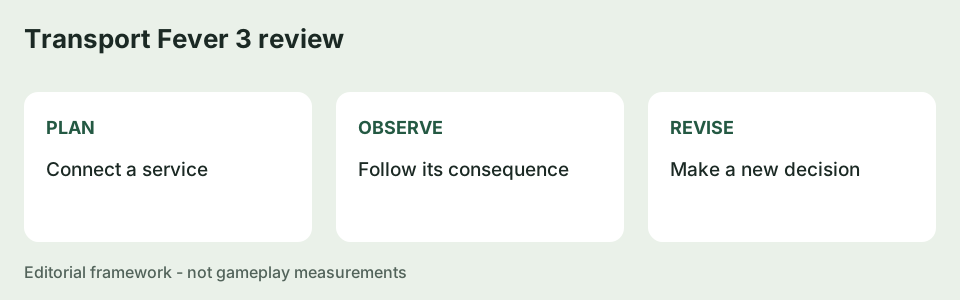
The satisfying idea is easy to recognize: a service connects places that previously could not exchange passengers or goods effectively, and the resulting activity gives the network a purpose. Town growth creates another reason to revisit a route. The appeal sits in the connection between a plan and its visible consequence, rather than in placing a vehicle and leaving it alone forever.
Campaign, Tycoon and Sandbox offer different frames for that work. A directed objective can give a new player a reason to build a particular service. A generated world asks for priorities; unrestricted construction puts more emphasis on the arrangement itself. These are different tests of the same tools. A successful introductory task does not tell us how comfortable those tools remain when the line list grows.
Our strongest positive judgment concerns that changing scale. A useful network is a project with consequences: improving a junction or revising a transfer can affect more than the vehicle directly in front of you. That is a better reason to care about expanded control than the size of a feature list. The corresponding design burden is substantial, however. The game must help the player understand which intervention matters.
More control, more work: both reactions can be justified
Warehouses can be an appealing construction system and a tiring operating system
Warehouse and lane construction can be absorbing even within an otherwise negative assessment. That is an important distinction. Enjoying the layout of a distribution site does not settle how much repeated attention its operating rules demand. Equally, frustration with those rules does not erase the attraction of building the site.
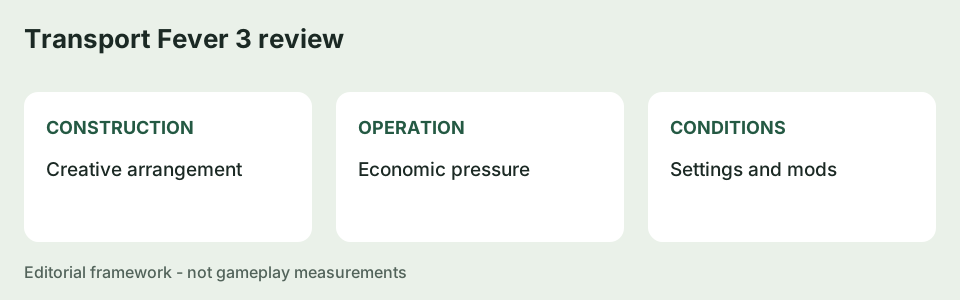
Our reading of this tension is that creative freedom and operating convenience should receive separate judgments. A flexible transfer arrangement earns credit when it enables a useful design. It loses credit when maintaining that design turns into repeating an adjustment without a new decision. Counting the extra settings alone would miss the difference.
Seeing a delivery and understanding a failed delivery are different strengths
Cargo movement can make a successful chain easier to follow. Yet showing where goods went does not necessarily explain why other goods stayed behind. Those observations can coexist. A display may be informative during normal operation and still leave an interruption difficult to diagnose.
This is where we would judge communication by the exception rather than the showcase. Does the information help locate the first unresolved handoff, or merely confirm that the part already working is active? That editorial test does not assume every stopped shipment is a software defect. It asks whether the management feedback helps distinguish a selection, a connection and an unknown cause.
A recommendation can contain serious criticism
A favorable overall recommendation can still come with substantial objections about economic pressure, fleet choices and repetitive management. It can also depend on altered settings or mods. Neither qualification should disappear when a recommendation is reduced to a positive or negative label.
Our conclusion is narrower than a claim that the economy is universally easy or universally broken. The conditions determine what the experience evaluates. Construction with pressure deliberately set aside is evidence about creative operation; it is not a test of the default financial challenge. Long playtime also does not identify which settings were active throughout that time.
Interface quality changes with the task
The useful question is not simply whether menus look cleaner. Finding a vehicle, changing a stop and revisiting a large collection of lines put different demands on them. Detailed controls can expand what is possible while making frequent tasks more cumbersome. Both effects belong in a review.
For that reason, our qualified verdict gives more weight to repeatable management work than to an attractive first view of a town. A tool that makes the next decision clearer supports the simulation. A tool that makes an already-decided action harder to carry out weakens it. This distinction is also why a controller-related complaint should stay attached to the controller context, rather than becoming a verdict on every platform.
Dated comparison: keep the conditions beside the verdict
Checked October 20, 2026. Hours are total-playtime counters displayed when checked, not hours at the original posting date, uninterrupted session lengths or our own testing time. Case labels only distinguish observations; they are not rankings.
Swipe the table sideways on a phone, or use the downloadable CSV.
| Case | Total hours displayed at check | Reported recommendation | Disclosed conditions | Experience being evaluated | What this does not prove |
|---|---|---|---|---|---|
| A | 31.7 | Not recommended | Series veteran; exact build and settings not established | Hidden actions and notification priorities impede management | Current-build reproduction or the frequency of the problem |
| B | 35.9 | Not recommended | Sandbox; town satisfaction intentionally disregarded | Lane and warehouse construction praised; stop management criticized | Default-economy balance |
| C | 121.3 | Recommended with qualifications | Normal difficulty discussed; custom settings and mods also disclosed | Long-term pressure and repetitive management criticized | The same result in an unmodified game |
| D | 59.8 | Not recommended | Exact build and settings not established | Road controls and cargo visibility valued; UI and diagnosis criticized | That visible cargo movement explains every failed movement |
Do not average these hours or use the recommendation labels to estimate the player population. These are selected experiences with different conditions. They establish that praise and criticism can concern different parts of the same management loop, not how often either response occurs.
A repeatable way to assess the management work
The review ledger includes the comparison and blank observation rows. These steps are our editorial review method, not a claim that we performed the session:
- Record the context first. Write your platform, installed build, game mode, economy settings and active mods. Leave an unknown field blank.
- Choose a transport task already present in the save. Note what you intend to improve and the observable result you expect. Keep purchase preferences out of this record.
- Follow the action through to its result. For a stop adjustment, record the selection you changed and what happened to the service. If the result remains unclear, keep it unresolved instead of assigning a cause.
- Separate decisions from repetition. Note which action required a new trade-off and which merely repeated a choice already made. If you count actions, record your actual count; the worksheet supplies none.
- Revisit at a different network scale. Keep the same task and record changed conditions. A compact network and a mature one need separate observations. Do not silently switch settings and present the result as a direct comparison.
The endpoint is an explanation of the task's quality: what choice became possible, what consequence made it satisfying, and what repeated work got in the way. That is more informative than treating every extra click as depth or every difficult decision as a defect.
Why can a negative assessment still praise the game?
Because the transport project and the effort of operating it are separable. A memorable junction or warehouse layout can be worthwhile while its repeated maintenance remains frustrating. Our assessment retains both: the network-building premise is strong, but the quality of management depends on whether feedback and controls turn complexity into understandable choices.
Verdict: compelling projects, uneven management friction
Transport Fever 3's strongest proposition is the connected transport project: growth gives a service another job, and a useful revision changes how the network behaves. The weakest part of that proposition is the administrative effort between the idea and the result. Extra control deserves credit when it enables a decision; it is harder to defend when it repeatedly obscures one.
This is a qualified editorial verdict, not a numerical score or a personal benchmark. The missing evidence remains visible: exact builds, changed settings and independently reproduced outcomes are not available for every experience. Do not turn a reported difficulty into a claim that it affects every current installation, or a positive session into proof that it affects none.
For purchase requirements, use the pre-purchase checklist. For delivered fixes and unresolved items, use the game-state guide. This review's conclusion concerns the quality of the management loop; it does not replace either task.
For the next practical question, follow the Transport Fever 3 No Path checks for a broken connection, use the Transport Fever 3 modern public transit plan for passenger networks, or inspect Transport Fever 3 player-reported problems before treating a proposed explanation as a confirmed repair.